Earth and smoke
A huge part of Islay’s success is the distinctive character of its whiskies: pungent, flavourful and peat-smoked. Peat is soil made up of fossilised plant matter – an early stage of coalification. On Islay, this is mostly heather, moss and seaweed that has decomposed for thousands of years.
The peat is cut from around two metres deep, where it is more moist and flavourful. The deeper you go, the harder and denser it gets, and the more it burns like coal – making it a traditional alternative to firewood on the island. But distillers are after smoke, not heat. A cool fire with moist peat is ideal, and releases the most flavour.
Slabs of peat are loaded into a furnace, to which wood and paper are added to get a fire started. The smoke rises up a chimney, filling a large kiln-room laid out with malted, slightly damp, barley. The smoke coats the barley, imbuing it with that all-important profile that has become so synonymous with Islay.
Subtle distinctions
It’s easy to think of Islay as uniform in its smoke, but across the island, there are subtle yet important distinctions. Along the south coast, Laphroaig, Ardbeg and Lagavulin present their smoke up-front. These are punchy drams: one sip, and the smoke hits you instantly, thick and oily. Further north, the peat influence emerges more softly: a hint of caramel, a touch of spice, then that beguiling wisp of smoke.
Here, in the north-west of the island, Bruichladdich produce a range of different whiskies varying in peat intensity, one of which isn’t peated at all.
“I think there’s sometimes this misconception that Islay whisky is all smoke and nothing else,” says Frazer Matthews, Bruichladdich’s Brand Ambassador, as he guides us around the Victorian distillery. “But the range of flavours on Islay is massive.”
A core part of Bruichladdich’s philosophy is focused on the grain itself – which is where the question of Islay-grown barley comes into focus. Bruichladdich work with 20 farmers around the island, who provide them with home-grown barley and allow them to speak proudly of supporting local agriculture, which, alongside hospitality, is the other major employer on Islay.
Home is where the heart is
Just up the road from Bruichladdich, we head next to Kilchoman for lunch. Founded by Anthony and Kathy Wills in 2005, Kilchoman was the first new distillery to be built on Islay in over a century. Unlike many of its neighbours, Kilchoman remains independent, championing a farm-to-bottle philosophy. The couple are very much involved in the day-to-day running of the distillery, alongside their three sons and a wider team.
We’re guided around the distillery by Kirsteen Turner; after living in South Africa for 30 years, she returned to her home island last year. The allure of Islay was too strong to resist. She tells me she would have returned earlier if it hadn’t been for the pandemic. “Home is where the heart is,” she says with a smile.
Robin Bignal, Kilchoman’s Production Manager, comes out to meet us. He explains that the Kilchoman philosophy is all about doing everything on site: growing the barley, malting, peating, bottling. Islay is on the goose migration path, so the barley is planted once the geese have departed in spring, left to ripen through the summer and harvested in autumn.
These are the grains that go into Kilchoman’s 100% Islay bottling – the embodiment of the Wills philosophy. The jewel in their crown, they’re keen for us to taste it before we leave. It’s just the thing to warm us up, before we continue our whisky journey on the other side of the island.
The whisky loch
Despite Islay’s huge success, a few of the people I speak to express a sense of caution. It’s clear that memories of the whisky crash of the 1980s – “the whisky loch” – are still very much alive.
A move away from peated whiskies resulted in the closures of Ardbeg, Bruichladdich, Bunnahabhain and Port Ellen distilleries, and the loss was keenly felt. Resulting in unemployment across the island, it’s little wonder that some are cautious about the seemingly unstoppable boom that’s taken Islay by storm.
Infrastructure is a topic that comes up again and again. “The transport’s just not equipped for this constant demand,” says Robin. “The ferries are really struggling at the moment. There’s a lot of pressure on companies to get produce on and off the island, just to meet demand, yet things keep booming. And you’re just wondering… when it’s all going to crash?”
The Islay wave
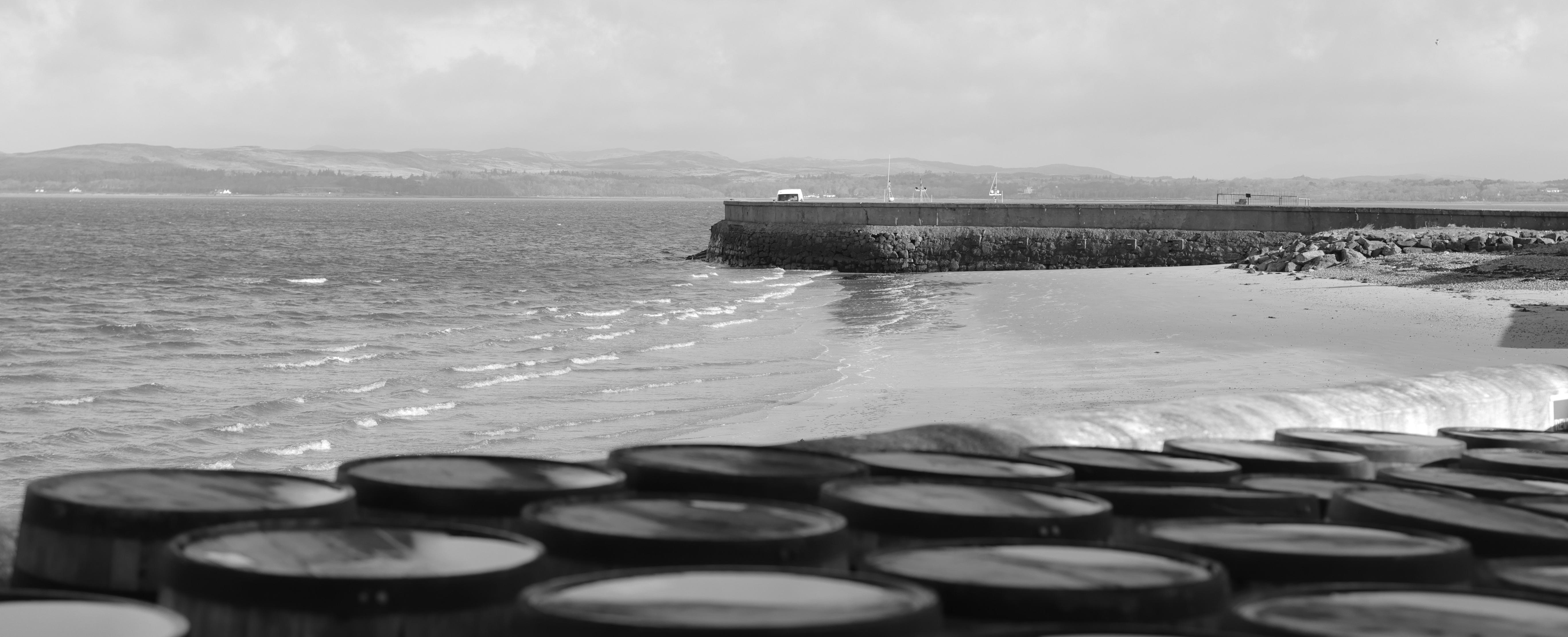
It’s a 40-minute drive across the island to Laphroaig – our final distillery visit. Outside the window, the sea sparkles in the late afternoon sun, as we sit down for a dram with Barry Macaffer, Laphroaig’s Distillery Manager. Barry’s connection to Laphroaig spans generations: his grandfather was born on the very site where the distillery now sits, and various members of his family have also worked here.
“I’m grateful that the generations that came before me preserved the distilleries and protected the island’s traditions, because we wouldn’t be where we are now without them,” he reflects. “Now, we must do the same for future generations.”
As Islay continues to grow and attract more visitors, the challenge, Barry says, is to meet the demand while “keeping it Islay”. The conversation turns to the topic of the “Islay wave”. If you ever drive around Islay, you’ll notice people waving at you in the car as they pass – an automatic hand raised in greeting. We even had a few waves from pedestrians as we drove by.
“It comes from the days when everyone knew each other,” says Barry, with noticeable pride. “The car you were passing was guaranteed to be driven by someone you knew. Nowadays, it’s a local custom, an old habit. But that’s the Islay way.”
If you saw a stranger lost in the street, you’d invite them in for a glass of whisky. “What would my mother say if I let you leave without a dram?!”
A tale of community
Today, the story of Islay is one of huge successes. But beneath the surface, it’s a tale of community: local people brought together by the craft of whisky-making.
Even to an outsider, the deep connections across the island are obvious. On the face of it, you might think the nine distilleries on Islay are natural competitors – but when you speak to the people who work there, they tell you about an aunt who works at X distillery, a partner who works at Y. They speak of collective memories and generational knowledge, pulling on threads across time.
The ongoing whisky boom is driving growth and employment, creating new opportunities and giving young people a reason to build careers on the island – and that is undoubtedly something worth celebrating. Can Islay continue to flourish while holding onto its unique character?
“We must protect what makes Islay Islay,” says Barry, as we finish our drams. “Little things like the Islay wave – we must never lose that. Oh, and adding whisky to your porridge.”